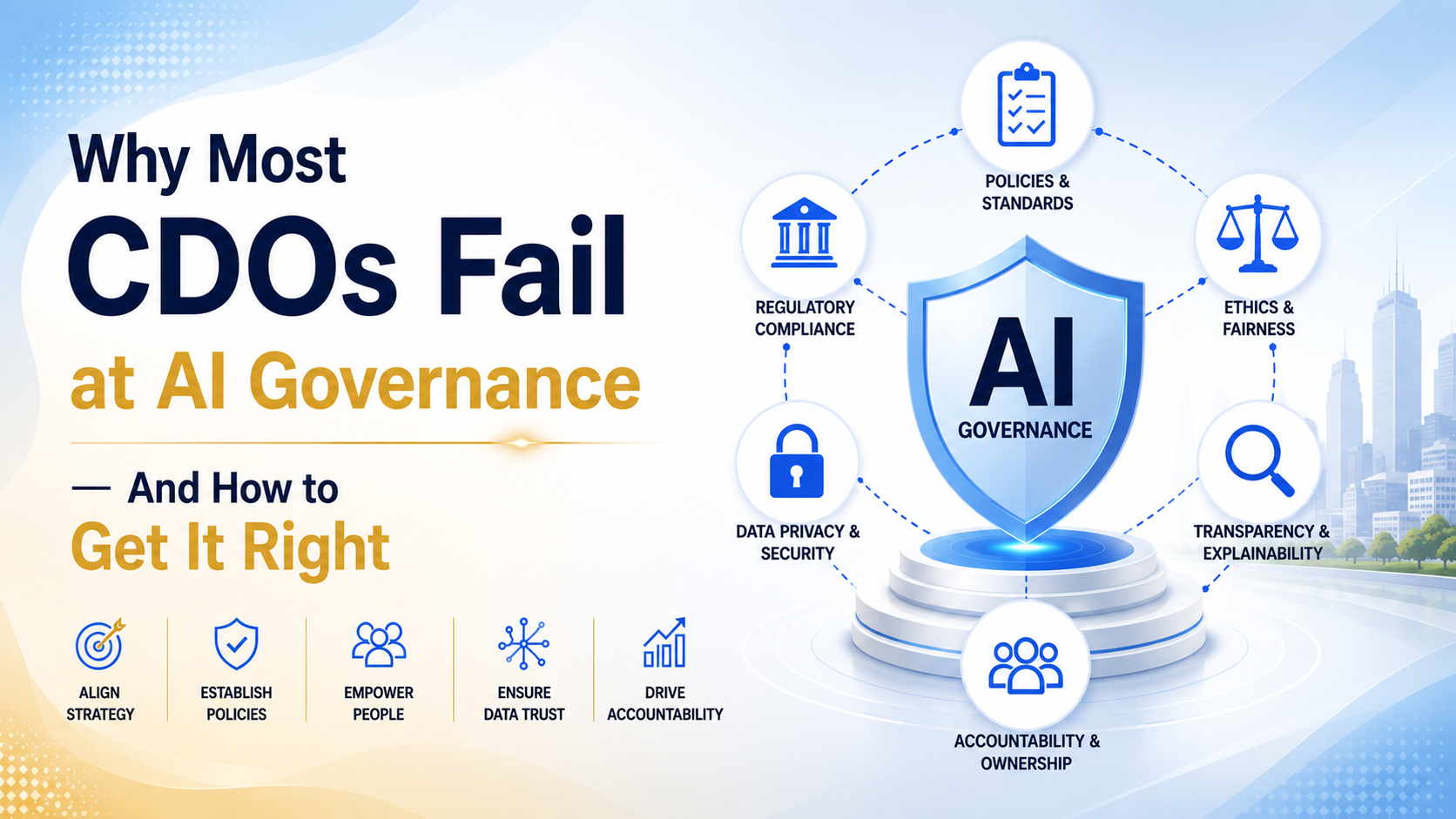
Why CDOs Fail at AI Governance – And the Exact Framework to Fix It
Most CDOs do not fail at AI because they chose the wrong model. They fail because no one built governance into the work – it was added afterwards, when the damage was already done.
I have watched this happen more times than I can count. A model goes live. Business teams start using it. Six months later, a regulatory review flags it – and nobody can explain why it was approved in the first place. No lineage trail. No bias test on record. No rollback protocol. Just a policy document sitting in a shared drive that nobody opened after the launch meeting.
This is not an edge case. This is the norm.
According to Informatica’s 2026 CDO Insights report – based on a survey of 600 data leaders – 76% say their company’s AI governance does not keep pace with how employees actually use AI. And Credo AI’s State of AI Governance 2026 report found that 60% of organizations are already deploying AI across multiple departments – yet only 4% are governing it at scale.credo+3
That gap is where AI programs go to fail.
I have spent 20-plus years building and fixing AI and data governance inside US financial services – writing frameworks from scratch, repairing broken ones, and sitting in the room when audit findings landed because nobody had treated governance as an operational discipline. This article is not theory. Every pattern I describe here comes from real programs, real failures, and real fixes.
Here is what I know about why CDOs fail at AI governance – and exactly what it takes to get it right.
What AI Governance Actually Means in 2026
Most people in this industry use the term “AI governance” and mean a policy document. A framework PDF. A risk committee that meets once a quarter. That is not governance – that is paperwork with a governance label on it.
Real AI governance is the system of controls that makes every AI decision in your organization traceable, auditable, and correctable. It means you can answer three questions at any point in time: Where did this data come from? Why did the model produce this output? And what happens if it goes wrong? If you cannot answer all three – quickly, with evidence – you do not have governance. You have documentation.
Here is what AI governance is NOT:
- A policy document that lives in a shared drive and gets updated annually
- A quarterly model review meeting where risk teams look at outputs, not logic
- A compliance checkbox that gets ticked at deployment and never revisited
- A responsibility that sits with legal or IT while the CDO owns the narrative
- A one-time audit exercise triggered by a regulatory request
The data makes this problem impossible to ignore. According to Informatica’s 2026 CDO Insights report – based on a survey of 600 data leaders – 76% of organizations say their AI governance does not keep pace with how employees actually use AI in practice. Separately, research from Digital Chiefs found that only 14% of organizations have clearly defined who is responsible for AI governance across their business. That means 86% of organizations deploying AI right now are doing it without a clear owner for what happens when something goes wrong.
That is not a governance gap. That is a governance void.
The reason this keeps happening is structural. Governance gets assigned to the policy function. Policies get written by people who are not close to the models. Models get built by engineers who are not reading the policies. And the CDO sits in the middle, owning the narrative but not the outcome.
Read our latest article: Meet Top 10 Female Chief AI Officers
I have said this to leadership teams more than once, and I will say it plainly here:
Governance is an engineering problem disguised as a policy problem. CDOs who treat it as policy will always be one audit away from a crisis.
The CDOs who get this right are the ones who stopped writing governance documents and started building governance systems – directly into their pipelines, their deployment checklists, and their post-launch monitoring. Everything else is just a version of hoping the problem does not surface before the next review cycle.
Also read: How I Deployed Enterprise AI Copilot to 9,000 Employees
The 5 Real Reasons CDOs Fail at AI Governance
If you want to understand CDO AI governance failure, do not start with policy language. Start with how AI programs actually move inside an enterprise. Models get built under delivery pressure. Business teams want speed. Technology teams want production timelines. Risk teams enter later. Compliance enters even later. By the time the organization starts asking governance questions, the model is already live, the output is already influencing decisions, and the clean point of control is gone.
This is why so many AI governance programs look mature on paper and fragile in reality. The structure exists. The documents exist. The committees exist. But the operating model does not. In my experience, CDOs do not fail because they do not care about governance. They fail because governance is positioned as a review layer instead of a built-in control system. That distinction is where most AI governance programs either become durable or collapse under pressure.
1. Governance Is Designed After the Model Goes Live
This is one of the most common causes of AI governance failure. The model is deployed first. Documentation is requested later, usually when a regulatory review, internal audit, or model risk team flags a gap. At that point, the organization is not governing the model. It is reconstructing a decision trail after the fact.
I have seen this play out inside real institutions. In one case, the third deployed model failed a regulatory review and nobody could show a clean lineage trail explaining why it had been approved in the first place. The team had output summaries, meeting notes, and scattered sign-off emails. What they did not have was a reliable system of record that showed data origin, validation logic, testing evidence, and approval rationale in one connected flow.
That is not governance – it is retroactive paperwork.
Fix: Build governance by design. Lineage tracking, bias testing, explainability, approval checkpoints, and rollback criteria must be part of the pipeline before a single model trains. If these controls appear only after deployment, they are too late to protect the business.
2. The CDO Owns the Policy but Not the Consequences
Many organizations say the CDO owns AI governance. What they usually mean is that the CDO owns the framework, the principles, and the reporting language. But the actual deployment decisions often sit with engineering, product, business units, and IT. That split creates one of the most dangerous patterns in enterprise AI – governance without enforcement authority.
A control that cannot stop a bad deployment is not really a control. It is a recommendation. This is why many governance models sound strong in steering committees but disappear under delivery pressure. Research shows that 48% of AI projects miss their business objectives because responsibility is not clearly defined between the CIO, CDO, and business units.
I have seen this problem surface repeatedly. The CDO is expected to answer for AI risk, but the power to delay, block, or redesign a model sits elsewhere. That arrangement guarantees weak governance because ownership is symbolic, not operational.
Fix: The CDO must own AI risk outcomes on paper, in process, and in escalation paths – not just governance documentation. If governance decisions cannot change delivery decisions, the operating model is broken.
3. No Shared Definition of “Data” Across the Business
Another major reason behind CDO AI governance failure is that the business does not actually agree on what its core data means. “Customer” can mean one thing to Risk, another to Compliance, another to Product, and something else again to Finance. Teams assume alignment because they use the same word. In reality, they are operating from different business definitions, different source systems, and different logic.
AI models trained on that fragmented understanding produce outputs that are impossible to govern consistently. The issue is not just data quality. It is semantic instability. If the business-critical entities are not standardized, every downstream governance conversation turns into an argument about language, ownership, and interpretation.
The fix I have implemented in practice is a shared semantic layer – one certified definition for each business-critical entity, enforced before model development begins.
Once that layer is in place, governance becomes faster and cleaner. Reviews move from debating terms to evaluating controls. Without it, governance meetings produce heat, not clarity.
4. Risk Teams Cannot Interrogate the Models They Approve
In too many organizations, governance sign-off happens at the output level, not at the model logic level. Compliance officers and risk reviewers are asked to assess impact, fairness, or acceptability without having enough technical visibility into why the model produced the result in the first place.
This creates a dangerous form of procedural confidence. Everyone feels that review happened, but the review was shallow. In regulated environments, black box liability is real. “We do not know” is not a valid response when a regulator, auditor, or internal control function asks how the model reached a conclusion.
The problem is not that risk teams are weak. The problem is that they are often set up too far from the technical reality of the model. They can review outputs, but they cannot meaningfully interrogate model behavior, training assumptions, feature logic, or control gaps.
Fix: Build cross-functional governance squads. ML engineers need to sit inside risk reviews, not outside them. Good AI governance requires technical interrogation, not just business interpretation.
5. Governance Stops at Deployment
Many enterprises treat deployment as the end of governance. They complete the checks, approve the release, and move on. Then silence. But production is where AI governance becomes most important. Once a model is live, the operating environment changes. Data distribution shifts. User behavior changes. Regulatory expectations evolve. A model that looked acceptable at launch can become risky very quickly.
This is why static governance is actively dangerous. It creates the appearance of safety while the real system keeps moving. Research summarizing MIT findings points to unchanged workflows as one of the main reasons AI governance programs fail. I agree with that. If governance does not continue after launch, it is not operating as a control discipline.
Strong AI governance for CDOs does not end with approval. It continues through monitoring, alerting, challenge, and review. That is how organizations stay ahead of model drift, control breakdowns, and audit surprises.
Fix: Put automated post-deployment monitoring in place, supported by monthly AI visibility audits and quarterly regulatory alignment checks. Governance has to function as an operating rhythm, not a launch event.
When you look across these five patterns together, the picture becomes clear. Most CDO AI governance failure does not come from a single catastrophic decision. It comes from small structural weaknesses that compound over time – weak ownership, weak definitions, weak technical review, and weak post-launch control. The organizations that get this right are not the ones with the longest governance documents. They are the ones that made governance part of how AI gets built, approved, and monitored every day.
What Good AI Governance Looks Like – From the Inside
This is the part most articles skip. They define an AI governance framework, list a few principles, and stop there. But that is not how CDO AI governance works in the real world. In practice, the difference between a stable program and a risky one comes down to what happens inside the operating model – who owns the data, who approves the model, what evidence exists, and what the organization can prove under pressure.
In one mid-size US financial institution, the problem was not a lack of interest in AI governance. The problem was that governance existed mainly as policy. The organization had 11 AI models in production. Three had no lineage documentation. Two had never been bias-tested. One had been live for 14 months past its review date. On paper, the governance framework existed. Operationally, it did not.
The Problem
The institution had grown its AI program quickly. Teams were shipping models into production because the business wanted faster decisions, better risk scoring, and more automation. But the control environment had not kept pace. Model documentation was inconsistent. Data ownership was unclear. Review cycles were manual. And when audit questions came in, the teams could not answer them with the speed or confidence they needed.
What I Found
What looked like a model risk problem was really a systems problem. Governance lived in separate documents, separate meetings, and separate teams. The risk team reviewed outputs. Engineering managed deployment. Data teams handled lineage inconsistently. No one had one connected view of the full model lifecycle. That is where most CDO AI governance programs start to fail. The framework exists, but the work is disconnected.
- Model approvals were not tied to evidence that could be traced later.
- Lineage was partial, manual, and dependent on individual teams.
- Bias testing was treated as a one-time task instead of a release control.
- Review dates were tracked, but not enforced through deployment operations.
- Business teams assumed a deployed model was a governed model, which was not true.
What I Changed
We did not start by writing another policy. We started by moving governance into the delivery process. That meant defining which controls had to exist before a model could be trained, which controls had to be satisfied before deployment, and which signals had to be monitored after launch. In other words, we turned AI governance from a document into an operating system.
Over 90 days, we introduced a practical AI governance framework built around three changes. First, we mapped critical data domains and assigned accountable owners. Second, we embedded model evidence requirements into the deployment path, including lineage, explainability, bias testing, and rollback readiness. Third, we set up recurring monitoring so governance would continue after go-live instead of ending there.
The Result
The result was not just cleaner documentation. The result was a better control environment. Audit readiness improved because evidence was easier to retrieve. Risk reviews became more substantive because engineers were part of the discussion. And the organization moved from reactive clean-up to proactive control. That is what good AI governance looks like in practice. It does not slow delivery. It makes delivery safer, clearer, and easier to defend.
My view: Good AI governance is visible in the workflow, not in the wording of the policy. If your team cannot show lineage, approvals, testing evidence, and post-deployment monitoring on demand, your governance framework is still too theoretical.
| Before | After |
|---|---|
| Governance lived in a policy document | Governance embedded in CI/CD pipeline |
| Quarterly manual model reviews | Automated monthly drift monitoring |
| Risk team reviewed outputs only | ML engineers joined risk review squad |
| No shared data definitions | Certified semantic layer in place |
| Models deployed, then documented | No model deployed without lineage sign-off |
The 3-Phase CDO AI Governance Framework
If you are looking for an AI governance framework that actually works, keep it simple enough to run and strict enough to defend. This is the structure I use when I assess whether a CDO AI governance model is operational or only aspirational.
Phase 1 – Governance by Design (Before the Model Builds)
This phase decides whether the rest of the AI governance framework will hold. Before any model work starts, define the data domains, the approved business definitions, and the standards that the data has to meet. If the organization has three different meanings of “customer,” “exposure,” or “risk event,” the model will inherit that confusion.
- Define data domains and semantic standards.
- Assign ownership clearly – who certifies the data, who approves the model, and who signs off on deployment readiness.
- Build lineage tracking into every data development pipeline.
- No data should be used in a model unless it has an assigned owner and an agreed quality score.
This is where CDO AI governance becomes real. The goal is not to create perfect data. The goal is to ensure that every important input has an owner, a definition, and a traceable path.
Phase 2 – Accountability at Deployment
Most organizations talk about governance, but the real test is what happens at release. A model should not go live because the deadline arrived. It should go live because the evidence is complete and the right people have signed off on it.
- No model goes live without an explainability document, a bias test result, and a rollback protocol.
- Governance squad sign-off is required – not just IT approval.
- The deployment checklist should be published internally and traceable by audit.
This part of the AI governance framework is where accountability stops being abstract. When approvals are tied to artifacts, review quality improves immediately.
Phase 3 – Continuous Governance Operations
AI governance does not end at launch. In fact, the highest-risk period often begins after the model is already in use. Inputs change. Behavior drifts. Regulations move. And teams assume the original review still covers the current state. It usually does not.
- Monthly AI visibility reports.
- Automated drift and anomaly detection alerts.
- Quarterly regulatory alignment reviews with legal and compliance.
- The CDO performance scorecard should include governance outcomes, not just model performance metrics.
That is what separates a durable AI governance framework from a launch checklist. Strong CDO AI governance stays active after production and keeps generating evidence over time.
Why Financial Services CDOs Face a Different Problem
AI governance in financial services is harder for one reason that many generic articles miss – most institutions are trying to govern modern AI on top of legacy architecture that was built for reporting, not for traceability, model reuse, or real-time control.
Legacy architecture changes the risk profile
In many financial institutions, data still sits across risk, finance, operations, and customer platforms that were never designed to work as one AI-ready layer. That means lineage is fragmented, definitions drift across teams, and model inputs often depend on reconciliation work that remains partly manual. For a CDO, this turns AI governance into both a data problem and an operating model problem.
Regulation is no longer a background issue
The EU AI Act includes penalties that can reach up to 7% of total worldwide annual turnover for certain prohibited practices. In parallel, explainability, documentation quality, and auditability expectations are rising across regulated environments, which makes weak AI governance financial services programs increasingly hard to defend.
There is another layer that matters now: generative AI. In financial services, RAG governance should be treated as mandatory for production use cases that depend on internal knowledge. Every LLM output used in a business process should trace back to a certified, auditable source. If the model can answer but the institution cannot prove the source, the control is not strong enough.
I see many teams underestimate this point. They focus on prompt quality, model selection, or user adoption. But in regulated settings, the harder question is simpler: can you prove where the answer came from, what source was used, and whether that source was approved? If the answer is no, the organization is carrying more regulatory and operational risk than it realizes.
My position is straightforward: AI governance financial services leaders cannot borrow generic enterprise playbooks and expect them to hold. They need a tighter model – stronger evidence, clearer ownership, more disciplined lineage, and RAG controls that treat source traceability as non-negotiable. Organizations that skip this are often one review cycle away from a material governance problem.