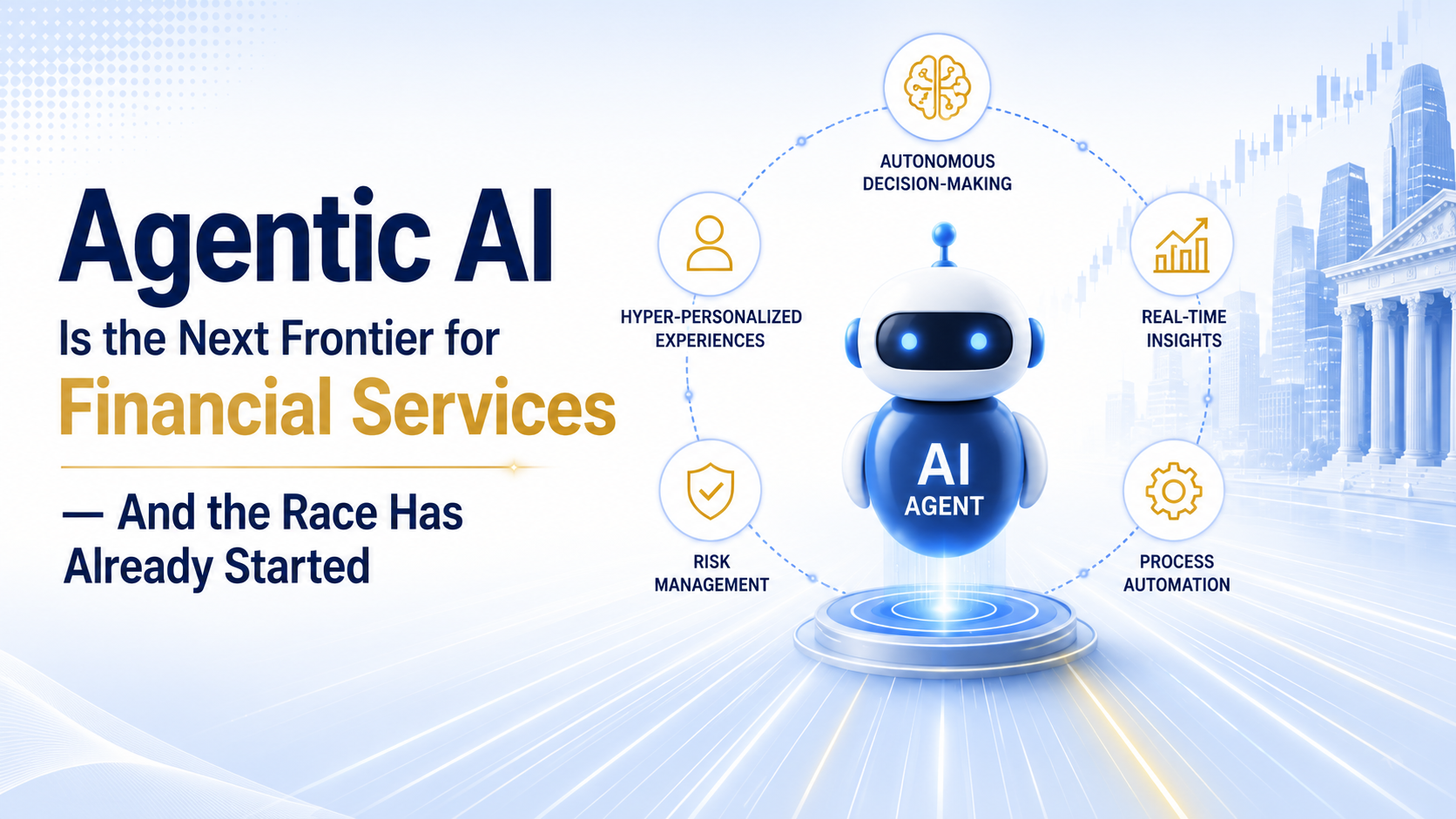
Agentic AI Is the Next Frontier for Financial Services — And the Race Has Already Started
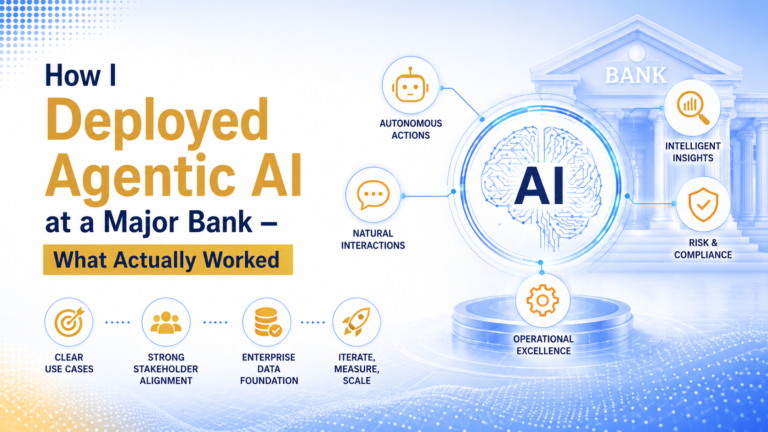
I have spent the last several years putting agentic AI into production inside regulated US financial institutions – not in a sandbox, not in a pilot, but in live systems handling real customer decisions, real fraud alerts, and real regulatory accountability.
This is what I have actually learned, not the conference-deck version.
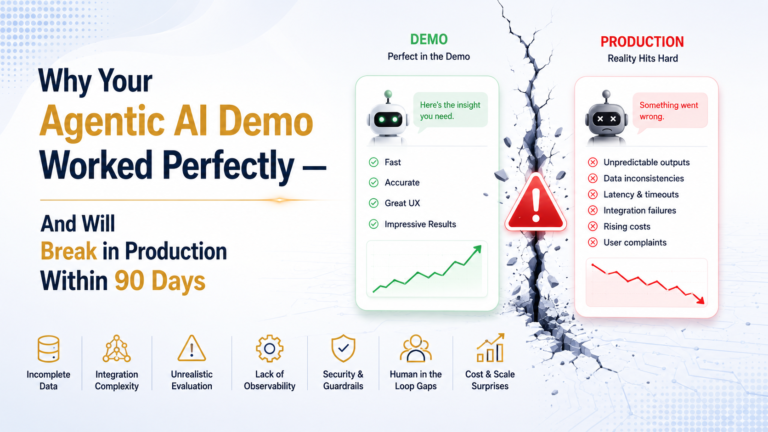
Industry estimates consistently put enterprise AI project failure rates somewhere between 70% and 85% before reaching stable production. In US financial services, that failure rate is not just a technology statistic – it carries model risk examination findings under the revised interagency guidance, CFPB scrutiny, and reputational consequences that compound fast.projectmanagement+3
Here is what the other 15% are doing differently.
Table of Contents
What Makes Agentic AI Different From a Chatbot?
A chatbot answers questions. An agent completes work. That single distinction reframes everything about how AI gets deployed inside a bank.
Traditional GenAI in financial services has been bolted on as an assistant — summarize this document, draft this email, answer this customer question. Useful. But limited. The human still picks up the output and decides what to do with it.
Agentic AI inverts the model entirely. The agent is given a goal — investigate this fraud alert, reconcile this exception, prepare this credit memo — and it plans the steps, calls the tools, reads the systems, and produces a finished work product with a full audit trace of how it got there.
At enterprise scale, that shift is worth far more than another GPT wrapper. It is the first time AI has been able to actually take work off a person’s desk instead of sitting next to it.
What Is Agentic AI?
Agentic AI is an AI system that autonomously plans, uses tools, and executes multi-step tasks toward a defined goal — with explicit checkpoints for human escalation and audit logging of every decision step.
The critical phrase in that definition is audit logging of every decision step. In a US regulated environment, that is not a feature. It is a compliance requirement.
Why Is Financial Services the Best Industry for Agentic AI Deployment?
This surprises people. Financial services is widely considered one of the hardest environments for AI — heavy regulation, conservative risk culture, complex legacy systems. Yet in my experience, it is actually the best beachhead for agentic AI production deployment.
Here is why.
Banks, insurers, and FinTechs share three properties that make them structurally ideal:
1. High-volume repeatable decisions. Fraud investigation, loan exception handling, KYC document review, credit memo preparation — these are processes that happen thousands of times per day, follow structured decision logic, and have clear definitions of a correct output. Agentic AI thrives on exactly this type of work.
2. Structured data with strong lineage. US financial institutions have spent decades building data governance infrastructure under regulatory pressure. The data quality, the audit trails, the access controls — these are already in place. Agentic AI needs governed data to function reliably. Most industries are still building that foundation. Banks already have it.
3. A regulatory framework that already requires explainability. The OCC’s SR 11-7 model risk management guidance requires documentation, validation, ongoing monitoring, and explainability for every model that influences a material business decision. Most industries treat this level of governance as overhead. In financial services, it is standard operating procedure.
When my team deployed agentic AI workflows for fraud investigation and exception handling at a major US financial institution, we did not need to invent governance from scratch. We extended the model risk management discipline that already existed under SR 11-7 to a new class of system. The guardrails were already there. We just had to apply them to agents instead of static models.
The same controls that make financial services hard for AI are exactly the controls that make agentic AI deployable there faster than anywhere else.
What Actually Breaks in Agentic AI Production?
The first failure of every agentic AI system I have shipped was not the model. It was not the infrastructure. It was not even the data pipeline — though that has been a close second.
It was the definition of done.
A static ML model has a clear success condition: the prediction is within acceptable accuracy bounds. An agent that can take 200 sequential actions across multiple systems does not have that luxury. You need to define — explicitly, in advance, for every action class — what successful autonomous completion looks like, and where the boundary is between “the agent handles this” and “a human needs to review this now.”
In one deployment, we discovered this the hard way. Our fraud investigation agent was completing cases autonomously at a 91% accuracy rate — impressive by any benchmark. But the 9% of cases it was getting wrong were all edge cases involving customers with multiple overlapping alerts. Exactly the cases where a wrong autonomous decision carried the highest regulatory exposure under CFPB consumer protection guidelines.
The fix was not the model. The fix was adding an explicit escalation rule: any case with three or more overlapping alert types routes to a human analyst, regardless of the agent’s confidence score.
Ninety-one percent autonomous resolution. Nine percent human review. That is a production-grade agentic AI governance model. Not 100% automation — intelligent automation.
How Do You Build Agentic AI That Survives in a Regulated US Bank?
Step 1: Build the Escalation Graph Before You Build the Agent
If you cannot write down — on one page — what an autonomous decision is allowed to look like and what triggers a mandatory human escalation, you are not ready to deploy.
The escalation graph is the governance document for your agentic system. It defines:
- Every action class the agent is authorized to take autonomously
- Every condition that triggers a mandatory human review
- The SLA for human escalation response
- The fallback behavior if the escalation queue is not actioned within SLA
Under OCC SR 11-7, this document is also your model risk evidence. Your examiners will ask for it.
Step 2: Use LangGraph for Stateful Orchestration
Linear prompt chains break the moment a workflow needs to branch, retry, or hold state across multiple tool calls. This is not a theoretical limitation — it is the failure mode of every early agentic prototype I have seen in production.
LangGraph solves this by enabling stateful, graph-based orchestration where each node in the workflow can branch conditionally, retry on failure, and maintain context across steps. For financial services workflows — fraud investigation, credit review, exception handling — where the path through a process depends on what was found at each step, LangGraph is the right architecture choice.
Step 3: Trace Every Step in LangSmith
Every action your agent takes in production needs to be logged, searchable, and explainable. Not for internal debugging — for regulatory examination.
LangSmith provides the observability layer that makes this practical: full trace logging of every agent decision, every tool call, every input and output. When your CFPB examiner or OCC model risk team asks “show me how the agent reached this decision on case #47382,” LangSmith is how you answer that question with evidence instead of estimation.
“The model decided” is not an acceptable answer in a US regulated environment. A complete LangSmith trace is.
Step 4: Treat Data Governance as Agent Infrastructure
An agentic AI system is only as reliable as the data it reads. If your feature pipelines have undetected drift, if your data quality scorecards are not monitored in real time, if your data ownership is unclear — your agent will make confident wrong decisions on bad inputs.
Enterprise AI governance in 2026 means extending your data governance framework upstream into every data source your agents consume. Every pipeline your agent reads should have: data quality monitoring, schema versioning, access audit logging, and a defined data owner from the business side.
Key Takeaways
- Agents replace work, not answers. The business case is hours-of-work removed, not query latency improved
- Financial services is the right beachhead. Existing model risk management frameworks under SR 11-7 accelerate agentic deployment — they do not slow it
- Define autonomy before you build it. Every action class needs an explicit human-escalation rule written before a line of code is written
- Use LangGraph for stateful orchestration. Linear chains break the moment a production workflow needs to branch or retry
- Trace every step in LangSmith. US regulators will ask how the agent made its decision, and “the model decided” is not a compliant answer
- Govern your data inputs, not just your model outputs. Agentic AI failures are upstream problems as often as they are model problems