How I Deployed Agentic AI at a Major Bank: The Complete Framework That Worked
I didn’t read about this in a whitepaper. I lived it.
Most content you’ll find on agentic AI in banking is written by consultants who sat across the table from the people doing the actual work. It’s polished, it’s safe, and it tells you almost nothing useful. This post is different – because I was the one in the room.
That context matters. Because deploying agentic AI in a regulated financial institution is nothing like deploying it at a SaaS startup. There are compliance walls. There are model risk governance frameworks. There are audit requirements that force you to rethink how an AI agent even makes a decision. And there are real people – risk officers, legal teams, business unit heads – whose sign-off you need before a single agent touches a production workflow.
This post covers exactly what happened when we moved from talking about agentic AI to actually shipping it:
- How we scoped the first agent – the discovery process, the decision mapping, the data audit
- How we governed it – compliance requirements, explainability mandates, the audit trail architecture
- How we shipped it – the tech stack, the integration work, the timeline
- What the results actually were – the numbers, the wins, and the one rollback that taught us more than any success did
By the end of this post, you will know exactly how agentic AI gets scoped, governed, and shipped inside a regulated financial institution – not in theory, but from someone who did it.
If you are an AI leader, a data officer, or a technologist trying to move your first real AI agent deployment in banking past the pilot stage and into production, this is the post I wish had existed when I started.
Let’s get into it.
What “Agentic AI” Actually Means Inside a Bank
Before we built anything, we had to agree on a definition. Inside a regulated institution, that word carries legal weight.
When I first brought the concept of agentic AI in banking to our internal risk and compliance team, the conversation stalled immediately – not because the technology was unfamiliar, but because the word “agent” had no agreed-upon meaning inside the institution.
That ambiguity is more dangerous than most technology leaders realize. In a regulated financial environment, what you call something determines how it gets governed, audited, and approved. If your definition is vague, your governance framework will be vague – and a vague governance framework does not survive a regulatory review.
So before we wrote a single line of code, we wrote a definition.
An AI agent is any system that can take autonomous action across multiple steps without requiring human approval at each step – where those actions produce real-world outcomes inside a live operational environment.
The most important line we drew early was the distinction between AI agents and AI automation. These are not the same thing – and in banking, treating them as the same is a governance failure waiting to happen.
Traditional Automation
Executes a predefined script. Every action is fixed at design time. It does exactly what it was told to do – no more, no less. The risk is known and bounded.
Agentic AI
Makes contextual decisions at runtime. Adapts based on new inputs. Can initiate downstream actions – flagging, drafting, routing – without a human trigger at each step. The risk surface is dynamic.
That distinction changed everything – not just for engineering, but for legal, compliance, and audit. An automation project follows one approval path. A deployment of AI agents in financial services requires a different risk classification, a different explainability standard, and a different oversight model. Once our risk team understood the distinction, the governance conversation became much more productive.
The 3-Criteria Internal Framework
To prevent ambiguity from creeping back in at the project level, we built a three-criteria framework. Every AI initiative we evaluated had to meet all three criteria to be classified as agentic AI – and therefore enter the agentic AI governance track. If it failed even one criterion, it was reclassified as automation and handled separately.
Perceive Context
The system must read and interpret situational context at runtime – not just process structured data fields. It must understand what is happening, not just what the record says.
Plan Across Steps
The system must sequence multiple actions toward a goal before executing any of them. Single-step decisions are automation. Multi-step planning with contextual sequencing is agentic behavior.
Initiate Real-World Action
The system must be capable of triggering an outcome in a live environment – updating a state, routing a case, generating a communication – without a human initiating each step.
This framework did something important beyond classification – it forced every project team to think precisely about what their system was actually doing. Vague AI projects rarely survive precise definitional criteria. The ones that did were the ones worth building.
Why This Definition Changed Our Entire Governance Approach
Once we had a precise definition and a classification framework, three things changed immediately.
First, the risk conversation shifted from “is this safe?” to “what is the authority boundary?” That is a far more productive question inside a bank. It is specific, it is auditable, and it produces a clear design requirement rather than an open-ended debate.
Second, the compliance team could engage constructively from Day 1. When compliance understands that an AI agent has a defined scope – what it can read, what it can draft, what it can never execute – they can write a governance policy. When the definition is vague, compliance defaults to “no.” A precise definition removes the most common blocker to deploying AI in regulated industries.
Third, it established Meenakshi Thanikachalam’s team as the internal authority on agentic AI governance – not just the delivery team, but the team that defined the rules. That positioning mattered throughout the entire 18-month deployment. When definition questions arose – and they did, repeatedly – there was one place the institution looked for answers.
The principle I took from this: In banking, the definition of a technology is not a semantic exercise. It is a governance document. Get it wrong, and everything downstream – the risk framework, the audit trail, the approval process – is built on an unstable foundation. Get it right, and LLM deployment in enterprise banking becomes a structured engineering problem rather than an open compliance risk.
How We Scoped the First Use Case
The first decision we made about deploying agentic AI in banking had nothing to do with technology. It had everything to do with the problem we were trying to solve.
That distinction sounds obvious. In practice, most enterprise AI programs get it backwards. A vendor demonstrates a capability, leadership gets excited, and the team spends six months trying to find a workflow that fits the demo. We did not do that.
We started by looking at where human time was being consumed at the highest volume and where the cost of a wrong decision was measurable. That led us directly to credit operations – specifically, the fraud review workflow.
“The question is never ‘Can an AI agent do this?’ The right question is: ‘Which parts of this workflow should an AI agent do – and where must a human remain accountable?'”
– Meenakshi Thanikachalam, Chief Data and AI Officer
The Baseline Problem
Before a single line of agentic code was written, we documented the workflow in full. An analyst flagged for potential fraud had to pull context from five separate systems – transaction history, customer profile, prior dispute records, velocity data, and network signals – synthesize that information, make a judgment call, and either escalate or resolve the case.
Average handling time: 14 minutes per case. We were processing thousands of flags per day. The volume was not sustainable, and the quality of decisions was inconsistent because analysts had variable access to context depending on which systems they prioritized.
The Core Scoping Question
Deploying AI agents in financial services is not a binary decision. You do not hand a workflow to an agent and walk away. You map every step, every decision point, and every downstream consequence – and then you draw a line between what the agent should do and where a human must remain accountable.
That line is not a technical boundary. It is a regulatory one. In banking, the accountability question determines your audit posture, your compliance exposure, and your model risk rating. We mapped the entire workflow against two criteria: Can an agent do this reliably? And Does a human need to own this outcome?
Here is the table that came out of that scoping exercise. This became the template we used for every subsequent AI agent deployment in banking we scoped after this one.
| Workflow Step | Agent Capable | Human Required | Reason |
|---|---|---|---|
| Pull data from 5 systems simultaneously | Yes | No | Deterministic retrieval – fully auditable, no judgment required |
| Identify pattern against prior fraud cases | Yes | No | Model decision – logged, explainable, and reproducible |
| Draft resolution recommendation | Yes | No | Drafted only – not executed; analyst reviews before action |
| Final approval and case action | No | Yes | Regulatory accountability – human sign-off required by policy |
| Customer communication | Partial | Yes | Agent drafts; human reviews for tone, edge cases, and empathy |
This table became our agentic AI scoping policy. Every new use case had to fill it out before engineering started. If the team could not answer “Human Required” with a clear regulatory or quality reason, the step went to the agent. If they could, the human stayed in the loop – by design, not by accident.
The Governance Framework We Built from Zero
This is the section that most articles on AI automation in banking operations skip entirely. It is also the section that determines whether your deployment survives its first compliance audit – or quietly becomes a liability.
When we began this program in 2023, there was no established governance standard for agentic AI in a regulated financial institution. The OCC’s model risk guidance was built for traditional ML models. Our internal AI policy covered algorithmic decision-making. Neither was designed for systems that plan across multiple steps, take autonomous actions, and operate at scale without human approval at each stage.
We had to build the framework ourselves.
The Three Source Frameworks We Combined
Rather than starting from a blank page, we identified the three existing frameworks that came closest to what we needed – and then documented every gap explicitly.
Covered model development, validation, and monitoring for traditional ML. We adapted its explainability and audit requirements for multi-step agent decision chains.
Defined who could access what data and under what conditions. We extended this to define what an agent could access, at what query frequency, and with what audit trail.
Provided the regulatory baseline for model accountability and independent review. We mapped every agentic component to a corresponding OCC requirement – and wrote new policy where no mapping existed.
We spent four months on governance design before a single line of agentic code was written. That timeline is not overhead. It is what makes everything downstream defensible in a regulated environment.
The 5 Components of Our Agentic AI Governance Policy
What follows is the exact policy structure we built for deploying AI in regulated industries. Every agent in our production environment operates under all five components simultaneously. None of them are optional.
Agent Registry
Every agent deployed in production is registered with a unique ID, a named owner, a defined scope of authority, data access permissions, and audit trail requirements. No agent operates in production without a registry entry. This is the foundation of all other governance components.
Authority Boundaries
Every agent has a defined and enforced scope of action. It can read, recommend, and draft. It cannot execute financial transactions, update customer records, or initiate external communications without an explicit human trigger. Authority limits are set at the registry level and enforced technically – not just by policy.
Explainability Requirements
Every decision an agent makes that influences a human outcome must produce a human-readable explanation. We implemented chain-of-thought logging at the model layer. Compliance does not accept a confidence score as an explanation. They need a narrative – and we built the translation layer to produce one.
Escalation Protocol
Any scenario the agent encounters that falls outside its training distribution triggers an automatic human escalation. The agent does not guess in edge cases. It stops, flags the case, and hands it to a human with a summary of what it observed. Silence is not an acceptable agent behavior.
Quarterly Audit
Every registered agent is reviewed quarterly against its original defined scope. Scope drift – where an agent gradually begins operating outside the boundaries it was designed for – is the highest-risk failure mode in long-running agentic deployments. The quarterly audit exists specifically to catch it before it becomes a compliance event.
Governance is not a constraint on agentic AI. It is the foundation of it. Every bank that has tried to bolt governance onto a live agentic deployment has paid for that sequencing in rework, audit findings, or both. Build the framework first. The technology becomes the easy part.
The Three Failures That Almost Killed the Project
The section vendor case studies never include
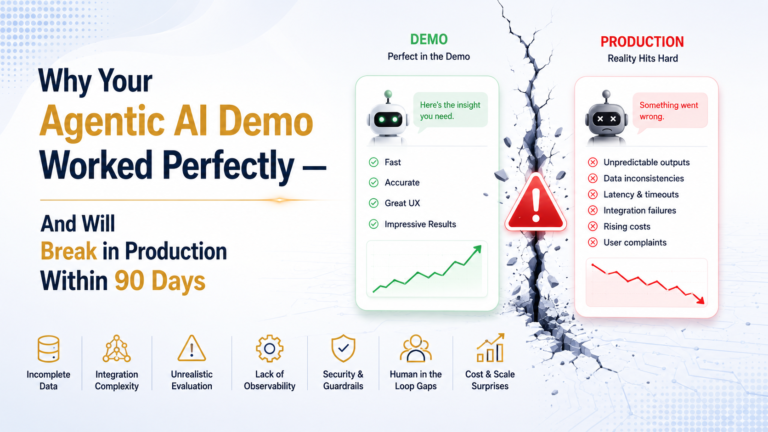
I am including this section because it is the most useful part of this article. If you are planning an agentic AI in banking deployment, the three failures below will save you months. None of them appear in vendor decks. All of them are real.
Failure 01
Context Window Limitations in Multi-Step Tasks
Our first production agent worked cleanly in a controlled test environment. In live operations, it failed on complex fraud review cases – and it took us two weeks to understand why.
The problem was context retention. A multi-system retrieval workflow requires the AI agent in financial services to hold context from Step 1 while executing Step 6. Early LLM architectures handled this inconsistently. In low-complexity cases, the agent performed well. In cases that required pulling data from five systems across a 12-step workflow, it was losing critical context mid-process – and making incomplete recommendations as a result.
How we fixed it: We redesigned the agent architecture into bounded sub-agents. Each sub-agent owned one clearly scoped step in the workflow. Context was passed explicitly between sub-agents using a structured handoff schema – not assumed to carry forward through the model. This added engineering complexity. It eliminated the failure mode entirely.
Failure 02
Data Governance Layer Not Built for Agent-Speed Queries
Our existing data governance infrastructure was built for human-speed access. An analyst pulling a report generates one or two governed queries per session. When we deployed an AI automation in banking operations agent at scale, it generated query volumes our governance layer had never been designed to handle.
The symptom was latency. Audit logs were falling behind real-time. In a regulated environment, that is not a performance issue – it is a compliance issue. If your audit log cannot keep pace with your agent’s actions, you cannot demonstrate accountability. That is a deployment-stopping problem.
How we fixed it: We rebuilt the data access layer with agent-native architecture – asynchronous audit logging, query rate controls per agent, and a dedicated governance pipeline that processed agent-generated queries separately from human-generated ones. The rebuild took six weeks. It should have been designed this way from the start.
Failure 03
Compliance and Engineering Misaligned on “Explainability”
This is the failure I think about most – because it was entirely preventable, and because I see it replicated in almost every LLM deployment in enterprise banking I hear about today.
Our compliance team required a plain-English explanation of every agent decision that influenced a customer outcome. That is a reasonable and legally necessary requirement. Our engineering team delivered a model confidence score and a feature importance list. These are technically accurate outputs. They are not the same thing as a compliance-ready explanation.
We spent six weeks in meetings between compliance and engineering before we had a shared definition of what “explainability” meant in a regulatory context. Six weeks. On a definition.
How we fixed it: We built a translation layer – a structured module that converts raw model outputs (confidence scores, attention weights, feature values) into templated narrative explanations that satisfy regulatory documentation requirements. That translation layer is now one of the most valuable components in our entire AI agents financial services stack. It took three weeks to build once we agreed on the spec. The alignment conversation took twice as long as the engineering work.
Key Takeaway
None of these failures were caused by the AI. All three were caused by gaps in architecture, infrastructure, and alignment. Fix those three things before you write the first line of agentic code.
The Results After Full Deployment
After 18 months – from first scoping call to full production – here is what the agentic AI in banking deployment delivered inside credit operations. These are not projections or pilot metrics. These are live production numbers from a system serving millions of banking customers.
77%
Reduction in Handling Time
14 min – 3.2 min per analyst review
34%
Drop in False Positive Escalations
Richer context retrieval per case
100%
Compliance Audit Pass Rate
3 consecutive quarterly audits
99.96%
Agent Uptime
Within core platform reliability standard
The 77% reduction in analyst handling time was the headline number. But it is not the most important result.
When an analyst spends 3.2 minutes instead of 14 minutes on a routine fraud flag, the 10.8 minutes recaptured does not disappear. It gets redirected toward complex cases – the ones that require actual human judgment, nuanced customer context, and experienced decision-making. The quality of those high-stakes decisions improved measurably, because analysts were no longer exhausted by the volume of routine work that an AI automation in banking operations system could handle more accurately than a fatigued human.
The 100% compliance audit pass rate across three consecutive quarters is the result I am most proud of – because it reflects the governance framework, not the model. Any organization deploying AI in regulated industries can build a high-performing model. Very few build a deployment that survives three compliance audits without a single finding. That outcome is a direct product of the four months we spent building governance before we wrote a single line of agentic code.
Second-Order Impact
Human decision quality improved – not because analysts were replaced, but because they were freed.
The most underreported result of a well-deployed AI agents financial services program is what happens to the humans working alongside it. When routine cognitive load is removed, experienced analysts apply deeper judgment to the cases that actually warrant it. The agent did not replace human intelligence in our deployment. It protected it.
What I Would Do Differently If I Started Today
Three decisions shaped this entire deployment – two were right from the start, one was not. If you are planning to deploy agentic AI in banking or any regulated industry, these are the lessons I wish I had in writing before we began.
Build Governance Before the Proof of Concept
We built governance in parallel with the proof of concept. That created expensive rework. In a regulated environment, your governance framework is not overhead – it is the foundation that every downstream decision sits on. When we had to retroactively apply authority boundaries and audit requirements to an agent already in testing, we lost six weeks and rebuilt two core modules from scratch.
The right sequence: governance first, PoC second. The PoC will move faster, not slower, because every design decision already has a clear boundary to work within. This is the single most important lesson I carry from deploying AI agents in a live financial services environment.
Invest in Agent Observability from Day 1
You cannot manage what you cannot see. By the time we had mature observability tooling in production, two of our three major failures had already happened. We were flying blind on context utilization, escalation trigger rates, and decision path tracing.
Real-time monitoring of agent decision paths is not a nice-to-have for AI automation in banking operations – it is a compliance requirement waiting to be enforced. Build it in from Day 1. Log every step, every context handoff, every escalation. When your compliance team asks what the agent did and why, you need an answer in seconds – not a post-mortem that takes three days.
Align Compliance and Engineering in Week 1 – Not Month 6
The explainability gap nearly derailed our entire project. Compliance needed plain-English decision narratives. Engineering delivered model confidence scores and feature importance outputs. Both teams were right – they were solving different versions of the same problem.
We spent six weeks building a translation layer that converted model outputs into compliant narrative explanations. That layer is now one of the most valuable components in our AI stack. But it should have been scoped in Week 1, not discovered as a gap in Month 6. Put compliance requirements inside the engineering specification before any model work begins. That single change saves more time than any technical optimization you will make later.
“Agentic AI in banking is a governance, architecture, and alignment problem that happens to involve advanced technology.”
Get the first three right – governance, architecture, alignment – and the technology becomes the straightforward part. Most teams I speak with are spending 80% of their effort on model selection and 20% on the organizational conditions that determine whether the model ever ships. That ratio needs to flip. Deploying AI agents in financial services is fundamentally a people and process challenge. The model is the last mile.