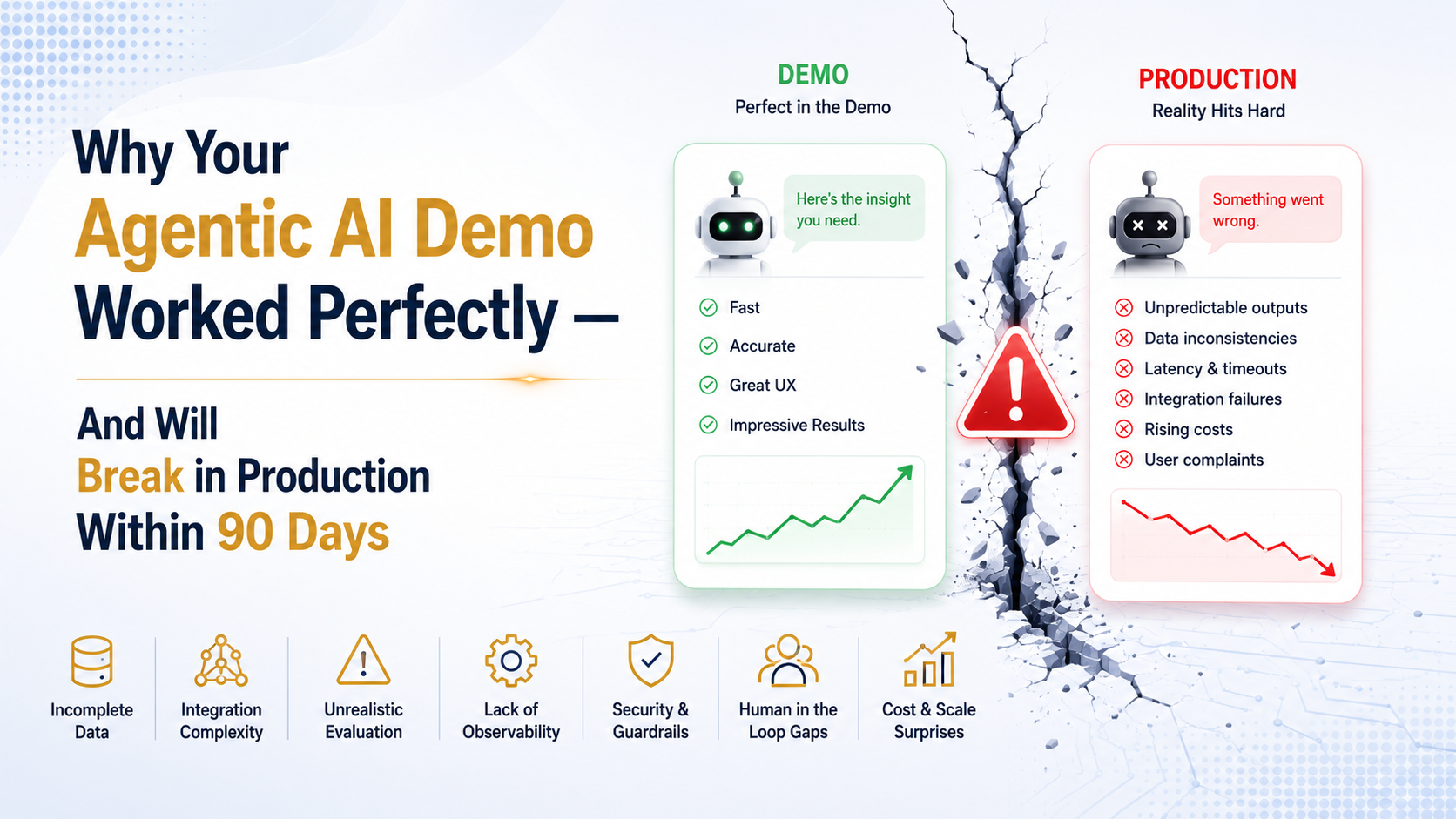
Why Your Agentic AI Demo Worked Perfectly — And Will Break in Production Within 90 Days
Every enterprise AI team I have worked with at major US financial institutions has had the same experience.
The demo runs flawlessly. Leadership is impressed. The project gets greenlit. Budget is approved. And 90 days after going live in production, the system is silently failing in ways nobody planned for — and in some cases, nobody even noticed.
This is not a technology problem. It is an Agentic AI governance problem. And it is the most expensive mistake US enterprises are making right now.
According to Gartner, 85% of AI projects fail before reaching stable production. In US banking and financial services, that failure rate carries regulatory consequences that go far beyond a missed KPI.
Table of Contents
Why Does Agentic AI Fail After a Successful Demo?
In a controlled staging environment, everything looks clean. The data is well-formatted. The pipeline is stable. The model outputs are exactly what you showed the steering committee.
Then production happens.
At one $75 billion US banking institution I worked with, we deployed a churn prediction system that performed at 94% accuracy in staging. Within 24 hours of going live, it started degrading. The root cause? The production data pipeline was pulling feature encodings with a 3% variance compared to the staging environment. A difference so small that no one caught it in QA.
We rolled the system back in four hours. But the damage to confidence — in the team, in the model, and in the broader enterprise AI transformation program — took months to repair.
Three percent. That is all it took.
Why Is Agentic AI Riskier Than Traditional ML Models in US Financial Services?
Static machine learning models make predictions. They output a score, a classification, a recommendation. A human reviews the output and decides what to do.
Agentic AI systems are fundamentally different: they take actions.
A multi-agent AI workflow in a US regulated enterprise does not just predict whether a customer might default — it may automatically trigger a credit review, flag a compliance record, or initiate a customer communication without human intervention.
In US banking, this creates an entirely new risk category. An AI agent that hallucinates a customer’s loan eligibility is not just an inaccurate output — it is a potential Equal Credit Opportunity Act (ECOA) violation. It is the kind of failure that lands simultaneously in front of your Chief Risk Officer, your legal team, and your CFPB examiner.
The OCC’s SR 11-7 model risk management guidance requires documented validation, ongoing monitoring, and clear accountability for every model that influences a material business decision. Agentic AI systems — because they act autonomously — sit squarely in scope.
The stakes of Agentic AI production failure in a US regulated environment are an order of magnitude higher than a static model getting a prediction wrong.
What Are the 3 Things Enterprise Teams Skip Before Deploying Agentic AI?
After two decades working in enterprise data and AI leadership across banking, FinTech, and healthcare, I have seen the same three gaps appear in almost every Agentic AI deployment that fails at scale.
1. Nobody Designed the Failure Modes Before Designing the Features
Every AI product requirements document I have reviewed spends 90% of its pages on what the system should do when it works correctly. Fewer than 10% address what happens when it does not.
Before a single line of production code is written, the team needs to answer:
- What does this agent do when its confidence score drops below threshold?
- What is the fallback behavior when the data pipeline fails mid-workflow?
- Who gets alerted when the system detects an anomaly — and within what SLA?
- Where is the human-in-the-loop intervention point?
- How does this system satisfy OCC SR 11-7 model documentation requirements?
Responsible AI design starts with failure. Teams that win in production design the edges before they design the features.ures.
2. Shadow Mode Was Skipped to Save Time
After the churn model failure I described, I made one change to our MLOps deployment process that we never reversed: every new model runs in shadow mode for a minimum of two weeks before it takes any production action.
Shadow mode means the new system runs in parallel with the existing system. It receives the same inputs. It generates the same outputs. But it takes no action. You watch it. You compare its behavior against what is already live. You look for drift, for unexpected outputs, for edge cases that staging never surfaced.
Two weeks in shadow mode has prevented at least six significant production failures in our program over three years. The time cost is two weeks. The downside prevention is measured in millions of dollars and avoided regulatory scrutiny.
3. Model Cards Were Treated as Optional Documentation
A model card is a structured document that describes what a model does, what data it was trained on, what its known limitations are, what populations it performs poorly on, and what monitoring is in place.
In many US enterprise teams, model cards are created after launch — if they are created at all. They are treated as documentation artifacts for auditors, not as delivery requirements for engineers.
This is backwards.
In a US regulated AI environment — banking, healthcare, insurance — a model that goes to production without a completed model card cannot be defended if something goes wrong. Under CFPB scrutiny or an OCC model risk examination, “we did not document it” is not an acceptable answer.
Make model card completion a go-live gate. Not a nice-to-have. A hard stop.
What Durable Agentic AI Actually Looks Like in a Regulated Enterprise
The teams building enterprise Agentic AI systems that survive — still running reliably 18 months after launch — share these non-negotiable practices:
Observability from day one. Tools like LangSmith, MLflow, and Arize are core infrastructure, not optional add-ons. If you cannot see what your agent is doing, why it made a decision, and how its behavior has drifted over time, you do not have an auditable AI system that satisfies US regulatory expectations. You have a black box in a regulated environment.
Human-in-the-loop controls as a design requirement. The goal of autonomous AI workflows is not to remove humans from every decision. It is to remove humans from decisions that do not require human judgment — and to route the ones that do to the right person at the right time. Under US consumer protection law, certain decisions — credit, collections, account closures — require human accountability by design.
Data governance as a product requirement, not a compliance checkbox. I have worked in organizations where data governance was owned by a compliance team and treated as a quarterly audit exercise. I have also worked in organizations where every data pipeline, every feature store, and every model input was governed, versioned, and monitored as a first-class product. The second type of organization deploys AI faster, with fewer failures, and with significantly higher confidence from both business leadership and federal regulators.
AI governance is not the enemy of deployment velocity. It is the infrastructure that makes velocity sustainable at enterprise scale.
The Uncomfortable Truth About AI Adoption in US Financial Services
The organizations struggling most with Agentic AI adoption in the United States are not struggling because the models are bad.
They are struggling because the infrastructure around the models — the data governance frameworks, the MLOps pipelines, the observability tooling, the human oversight architecture — was never designed to support autonomous AI operating inside regulated business processes.
McKinsey estimates that US financial institutions that invested in data infrastructure before 2022 are deploying AI three times faster than those who are building foundations and models simultaneously. The compounding advantage of doing the foundation work early is enormous.
Agentic AI is not a model problem. It is a systems problem. And systems problems require architectural solutions, not more demo cycles.
Responsible AI Is Not the Enemy of Fast AI
There is a persistent belief in US boardrooms and technology leadership teams that governance, oversight, and compliance requirements slow down AI deployment. That the choice is between moving fast and building responsibly.
This belief is wrong. And in a post-CFPB-enforcement, post-OCC-guidance US regulatory environment, it is also dangerous.
Responsible AI is not a constraint on speed. It is the architecture that allows speed to be sustained. Every team I have seen skip governance in the name of velocity has eventually paid a tax — in production failures, in regulatory examination findings, in lost business confidence — that cost far more than the time they saved.
The fastest path to enterprise AI transformation in US financial services is building it right the first time.
Hi, this is a comment.
To get started with moderating, editing, and deleting comments, please visit the Comments screen in the dashboard.
Commenter avatars come from Gravatar.