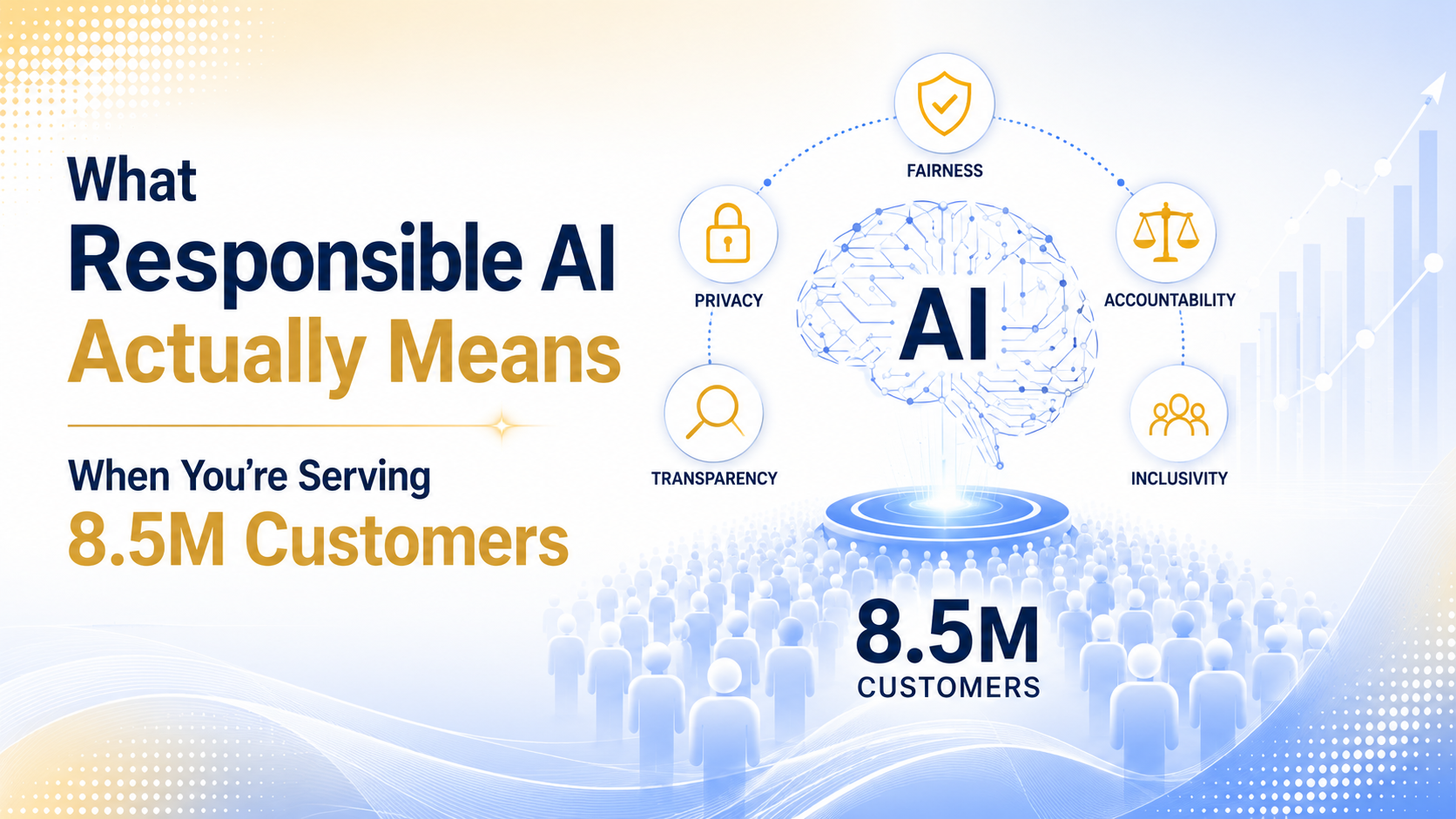
What Responsible AI Actually Means When You’re Serving 8.5M Customers
At Ally Financial, our AI systems ran across 8.5 million customers — making or influencing decisions on credit, fraud, collections, and customer communications every single day.
At that scale, responsible AI stops being a philosophical statement. It stops being a slide in your ESG deck. It becomes an operations problem — one that your engineering team, your compliance team, your customer service team, and your regulators all have a stake in simultaneously.
According to McKinsey, only 35% of US enterprises have a formal responsible AI framework in production. The remaining 65% are operating with good intentions and no operational infrastructure. In US financial services, good intentions do not satisfy the Equal Credit Opportunity Act (ECOA), the Fair Housing Act, or CFPB supervisory expectations on algorithmic decision-making.
Here is what I have learned from the other side of that gap, as Chief Data & AI Officer leading enterprise AI and data transformation across regulated financial institutions.
Table of Contents
What Changes When Your AI Serves Millions of People?
At small scale, a model bug is an embarrassment. You fix it, you move on, you improve the next version.
At 8.5 million customers, the same bug is a regulatory event.
The math of responsible AI at enterprise scale is brutal and non-negotiable:
- A 0.1% disparate impact rate sounds like a rounding error. It is 8,500 affected customers.
- A 1% false-positive rate on a fraud-detection model means 85,000 customers had legitimate transactions wrongly declined — each one a potential complaint, a potential churn event, a potential CFPB inquiry.
- A model that degrades silently by 3% accuracy over six months — because nobody set up drift monitoring — affects a cumulative population in the millions before anyone notices.
This is the responsible AI mathematics that enterprise teams rarely talk about in public. Scale does not just amplify your successes. It amplifies every failure mode at the same rate.
The question is not whether your AI model is ethical in principle. The question is whether your AI governance infrastructure is operational at the scale you are actually running.
The Three Responsible AI Failures I Have Seen — And Fixed
In two decades of enterprise AI leadership across US financial institutions, I have seen hundreds of AI deployments. The responsible AI failures almost always trace back to one of three root causes. Not model quality. Not data volume. Operational gaps.
Failure 1: No Fairness Baseline Was Established at Launch
You cannot detect drift in fairness if you never measured fairness at launch.
This sounds obvious. It is almost universally skipped.
Teams build a model, validate it on accuracy metrics — AUC, precision, recall — and deploy. Fairness metrics across demographic segments are treated as a post-launch audit item. Something to check when a regulator asks or a complaint surfaces.
The problem is that without a launch baseline, you have no reference point. When your model’s approval rate for a specific demographic segment shifts six months after deployment, you cannot tell whether it was always that way, whether it changed gradually, or whether a specific data pipeline update caused a sudden shift. You have no before.
The fix: Establish a fairness scorecard at launch — approval rates, false positive rates, and disparate impact ratios across protected class segments, measured on the same holdout data used for accuracy validation. This baseline becomes your monitoring reference point for every subsequent measurement. Under CFPB fair lending supervision, it also becomes your evidence that you measured and managed algorithmic fairness from day one.
Failure 2: No Escalation Path Was Defined
AI makes a decision. A customer disputes it. And there is no defined human in the loop.
This failure mode is more common than it should be in 2026, and it is the one that generates the most regulatory exposure. Under ECOA and the Fair Credit Reporting Act (FCRA), customers have specific rights to explanation and dispute when AI influences adverse decisions on credit, insurance, and financial products.
“Our AI model made that decision” is not a legally sufficient explanation. It is not an explanation at all.
In one deployment I inherited, a collections workflow had been running autonomously for eight months. The system was performing well by its accuracy metrics. But there was no defined path for a customer who believed the AI had made an error. Customer service representatives had no visibility into the AI decision logic. Complaints were being resolved by manual override without documenting why the override was made. The escalation path was improvised, case by case, by whoever picked up the phone.
The fix: Every AI system that influences a customer-facing decision must have a defined escalation path before it goes live. This means:
- A human reviewer role with access to the model’s decision trace
- A defined SLA for escalation response (we used 48 hours for credit-adjacent decisions)
- A documented override process that records both the override decision and the reason
- Customer-facing language that explains, in plain English, that a human review is available upon request
This is not just good practice. For credit and lending decisions in the US, it is required under Regulation B adverse action notice requirements.
Failure 3: No Drift Monitoring Was In Place
Models silently degrade. And no one knows until a regulator calls, a complaint volume spikes, or an internal audit surfaces an anomaly that has been accumulating for months.
AI drift monitoring is the most technically straightforward of the three failures to solve — and the one most consistently deprioritized. The reason is that drift is invisible until it is not. A model that was 94% accurate at launch and is now 87% accurate after 14 months of data distribution shift will not announce itself. It will just quietly produce worse decisions at scale.
In US financial services, where models influence millions of decisions annually, a 7-point accuracy degradation does not stay statistical for long. It becomes customer outcomes. It becomes complaint patterns. It becomes examination findings.
The fix: Implement three layers of drift monitoring for every production AI model:
- Data drift monitoring: Track input feature distributions against the training baseline. Tools like Arize AI and Evidently flag when the data the model is seeing today looks meaningfully different from the data it was trained on.
- Model performance monitoring: Track accuracy, false positive, and false negative rates on a rolling 30-day window against the launch baseline. Set alert thresholds — we used a 3-point degradation trigger for review and a 5-point trigger for mandatory revalidation.
- Fairness drift monitoring: Run the launch fairness scorecard on a monthly sample. If disparate impact ratios shift outside acceptable bounds, trigger a model risk review immediately — do not wait for the quarterly audit.
Responsible AI as a Trust Asset — Not Just a Risk Control
I want to reframe something that comes up in almost every C-suite AI conversation in US financial services.
Responsible AI is consistently positioned as a cost — the governance overhead, the compliance requirement, the thing that slows down deployment. It is framed as risk mitigation: doing it to avoid the downside.
This framing is incomplete. And it causes teams to underinvest.
Responsible AI, done operationally and consistently, is a trust asset. It compounds over time with both customers and regulators in ways that are genuinely difficult to replicate.
Customers who receive transparent explanations for AI decisions — who have a clear path to dispute, who are treated with the same standards regardless of which demographic segment they belong to — become customers who trust the institution’s AI more broadly. That trust translates into higher product adoption rates, lower churn, and stronger Net Promoter Scores.
Regulators who examine an institution with a mature, documented, operationally embedded responsible AI framework — with fairness baselines, escalation graphs, drift monitoring dashboards, and model cards for every production system — have a fundamentally different examination experience than regulators examining an institution running on good intentions and ad-hoc oversight.
The second type of institution gets faster approvals for new AI use cases. It builds credibility capital with its supervisory team. It is treated as a responsible innovator rather than a compliance risk.
At Ally Financial, our investment in enterprise AI governance infrastructure did not slow down our AI program. Over four years, it accelerated it — because every new deployment had a proven governance framework to plug into rather than building oversight from scratch each time.
Key Takeaways
- Scale changes the math. A 0.1% error rate at 8.5M customers is 8,500 affected people — not a rounding problem
- Measure fairness at launch. Without a baseline, you cannot detect drift, and you cannot defend your model under CFPB fair lending supervision
- Define the escalation path before deployment. Every customer-facing AI decision needs a documented human review path — required under ECOA and Regulation B for credit decisions
- Monitor drift always. Silent degradation is the most common production failure in long-running AI systems — and the one least likely to be caught without automated monitoring
- Responsible AI is a trust asset. Institutions with mature AI governance frameworks get faster regulatory approvals, stronger customer trust, and lower examination risk — not just fewer compliance findings
- The infrastructure investment compounds. Every governance framework built for one model accelerates the next deployment