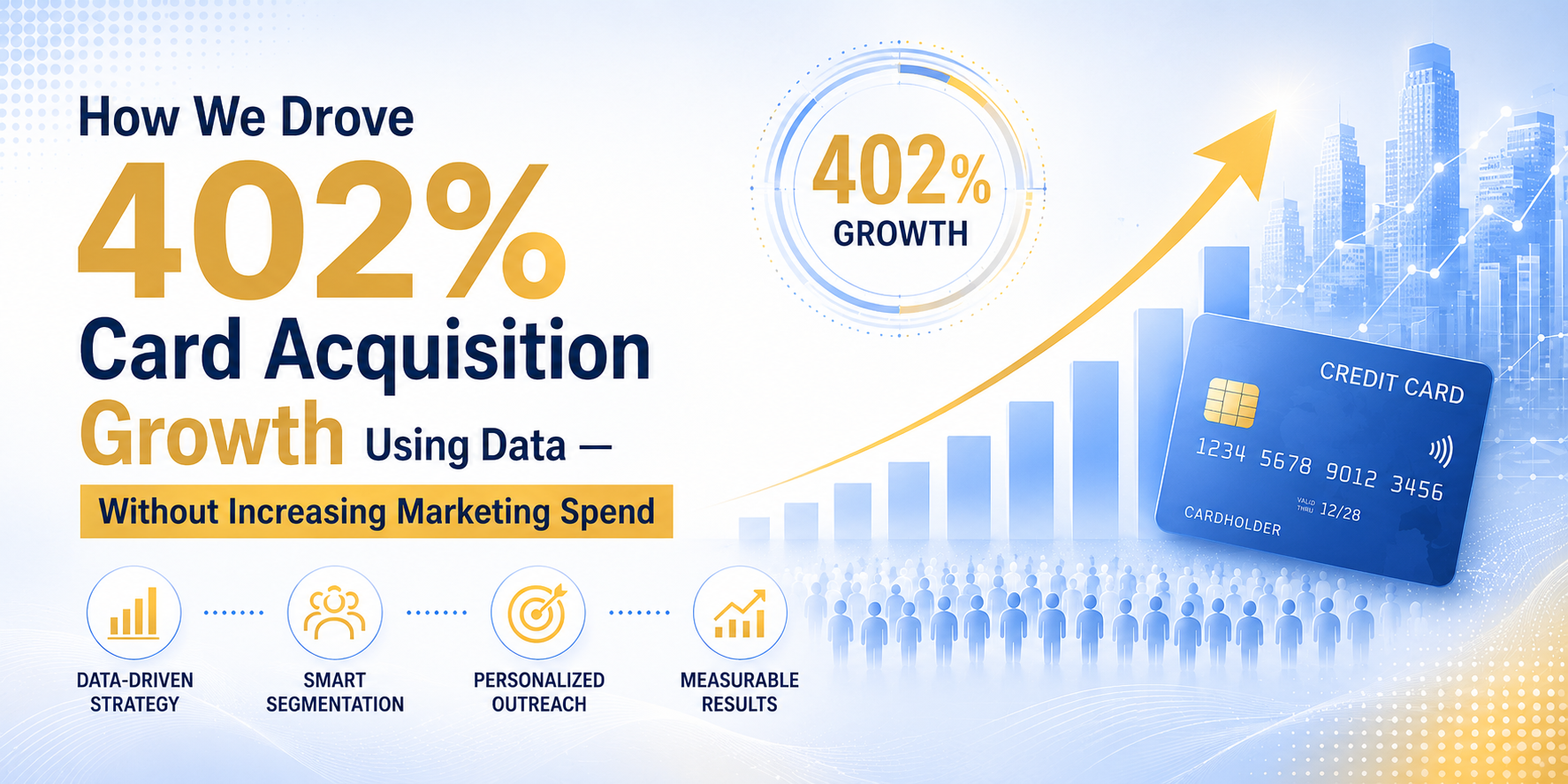
How We Drove 402% Card Acquisition Growth Using Data — Without Increasing Marketing Spend
Most banks talk about data-driven growth. Very few can show you the architecture that actually produced it.
This article is not about strategy decks or vendor roadmaps. It is about the exact data infrastructure – the pipelines, the governance framework, the AI/ML models – that drove a 402% lift in card acquisition inside a major U.S. digital bank managing over $75 billion in assets.
I was the Chief Data and Technology Officer responsible for building it.
My mandate was clear: unify 8.5 million customers across auto, mortgage, deposits, and card products into a single governed data platform – and use that foundation to power acquisition growth at scale.
This is not a consultant’s whitepaper. I built this.
What follows is a practitioner’s breakdown of the data architecture for card acquisition growth in banking – the decisions that worked, the mistakes I avoided, and the governance layer that made the results repeatable, not accidental.
If you are a CDO, a data engineering leader, or a senior executive trying to understand why your banking customer acquisition AI data strategy is not producing the numbers it should – this article is written for you.
The Real Reason Card Acquisition Programs Fail
I have sat in enough acquisition post-mortems to know how they usually end. The team blames the campaign. The agency blames the targeting. Leadership asks for a new model.
And then the same thing happens the next quarter.
Here is what I have consistently found: most card acquisition failures are not marketing failures. They are data failures. The campaign was fine. The model was fine. The data feeding that model was not.
When I stepped into my role as Chief Data and Technology Officer at a $75B U.S. digital bank, I inherited exactly this situation. 8.5 million customers across auto lending, mortgage, deposits, and credit products – each living in a separate system, with no unified customer record connecting them.
The acquisition models we had were being trained on a partial view of the customer. They were scoring creditworthy customers as low-propensity and ignoring high-intent signals that only appeared in cross-product behavior. The result: wrong segments targeted, budget wasted, and a customer acquisition cost (CAC) that kept climbing with no improvement in conversion rate.
My first diagnosis was not “we need a better model.”
It was: we need a better data architecture for card acquisition growth in banking. The model was the symptom. The architecture was the problem.
Here is what fragmented data does to an acquisition program in practice:
- A customer with an auto loan and a mortgage – high creditworthiness signals – is invisible to the card acquisition model because deposits and lending data are never joined
- Propensity scores are calculated on demographic data alone, missing behavioral intent signals entirely
- Offer optimization cannot run because there is no unified view of what each customer already holds
- Every model retrain requires a manual data pull from five different teams – with no lineage, no versioning, no quality guarantee
Building Customer 360 – What It Actually Takes
Let me be direct about something that gets misrepresented constantly: Customer 360 is not a dashboard. It is not a reporting layer. It is an architectural decision – one that determines whether every downstream model, campaign, and analytics program will produce results you can trust or results you have to explain away.
Building a Customer 360 data platform for financial services at the scale of 8.5 million customers across multiple product lines required making four foundational design decisions before a single model was trained.
The reason I am telling you the specific tools and specific numbers is this: banking customer acquisition AI data strategy only works when the infrastructure beneath it is precise, governed, and documented. Vague architecture produces vague results.
Now, the honest part.
Building this foundation took longer than any stakeholder wanted. There were quarters where leadership asked why acquisition numbers had not moved yet. The answer was always the same: because we are building something that will hold when we push 953 million dollars in card transaction volume through it. We are not building for this quarter. We are building for the next three years.
Every downstream AI model – propensity scoring, offer optimization, churn risk suppression – ran against this same governed Customer 360 layer. Not a sample. Not a cleaned export. The actual, governed, monitored, lineage-tracked source of customer truth. That is what made the 402% card acquisition growth a repeatable outcome, not a one-quarter anomaly.
The principle I applied here is one I carry into every enterprise data architecture engagement: you cannot build a trustworthy AI system on top of untrustworthy data. The foundation is not the preparation for the work. The foundation is the work.
The Three AI Models That Drove the 402% Lift
Not one model. Three – working in coordination. Here is exactly how they were designed, what each one did, and why the architecture behind them mattered as much as the models themselves.
Most teams build one propensity model, run a campaign, and call it a data-driven program. That is not what we built. Every AI model for card acquisition in banking that we deployed was designed to work as a coordinated system – not as three independent experiments. That coordination is where the lift came from.
Propensity Scoring
The first question we had to answer was precise: which customers in our 8.5M base were most likely to accept a card offer – right now, not in general?
- Trained on unified Customer 360 signals across auto, mortgage, deposits, and credit
- Input features: cross-product behavior, payment consistency, lifecycle stage, recency of activity
- Output: a real-time propensity score per customer, refreshed on a defined cadence
- Replaced broad segment targeting with individual-level scoring
Dynamic Offer Optimization
Knowing who is likely to accept is not enough. The second model answered a different question: which offer variant converts best for which customer segment?
- Scored offer variants in real-time against behavioral triggers
- Eliminated one-size-fits-all offer logic that was inflating CAC without improving conversion
- Integrated directly with the campaign execution layer – no manual handoff
- Continuously updated as behavioral signals shifted post-Fair Square integration
Churn Risk Suppression
This is the model most acquisition programs skip – and it is the reason most acquisition programs leak value within two quarters.
- Acquisition without retention is a leaking bucket
- Churn risk scoring ran in parallel from Sprint 1 – not bolted on at the end
- Customers flagged as high churn risk were routed to a separate retention-first journey
- Prevented the program from posting strong acquisition numbers while quietly losing the base
The Critical Architecture Decision – One Feature Store. Three Models.
Here is the call that made all three models work as a system rather than three separate experiments producing three different versions of customer truth.
All three models ran against the same governed feature store. Every input feature – behavioral signals, payment data, lifecycle variables – came from one source. Not three team-specific data pulls. Not three different definitions of “active customer.” One governed, monitored, auditable feature store that the entire AIML credit card growth banking program ran on top of.
This is not a technical footnote. It is the reason the models agreed with each other when they needed to – and why, when a data quality issue appeared upstream, we caught it once instead of three times across three separate pipelines.
The Fair Square Integration – Where the Numbers Materialized
The Fair Square Credit Card acquisition was not just a product launch. It was a live stress test of every architectural decision we had made over the previous 18 months.
When the integration went into production, the enterprise data architecture for card acquisition had to absorb three things simultaneously – at scale, without degradation, without a separate stack.
- Onboarding 1.2 million new customer accounts into the existing Customer 360 framework without breaking a single data quality rule
- Supporting 953 million dollars in card transaction volume through the same governed pipeline that was already serving 8.5 million existing customers
- Running real-time fraud scoring and credit decisioning on the same infrastructure – no parallel stack, no emergency workaround, no exception to the banking customer acquisition AI data strategy we had established
None of this was handled reactively. The architecture was designed to absorb exactly this kind of load before the acquisition was announced. The integration succeeded not because the team moved fast under pressure – but because the data foundation was built to be extensible from the start.
When the 402% card acquisition growth number surfaced in reporting, it was attributed to campaign performance and offer strategy. And those teams deserve credit – the campaigns were well executed. But the reason the numbers held, scaled, and repeated across quarters was the Customer 360 data platform for financial services underneath them. Without that foundation, the same campaigns would have produced the same results every other bank was seeing.
The Governance Layer Most Teams Skip
I have seen smart, well-resourced data teams build impressive acquisition models and watch the results collapse after two quarters. The models were not the problem. The governance was missing.
Governance is the part of data architecture for card acquisition growth in banking that does not appear in vendor demos. It is invisible when it is working correctly. It becomes very visible – and very expensive – when it is not.
Three governance decisions directly protected and sustained our acquisition results:
1. Data Lineage for Every Model Input
Every feature feeding into every acquisition model was traceable end-to-end. When a model produced an unexpected output, we could trace the root cause to a specific data source in minutes – not days, not weeks. In a regulated environment, that speed is not a convenience. It is a risk management requirement. This is what enterprise data architecture in FinTech looks like when it is built correctly.
2. 1,500 Data Quality Rules in Collibra
Automated monitoring across 1,500 data quality rules ran continuously against the platform. When data degradation occurred upstream, the system flagged it before it reached model inputs. No model was ever scored against corrupted or stale data without an alert triggering first. That single design decision protected the integrity of every AI/ML model for credit card growth running on the platform.
3. SR 11-7 Compliant Model Cards – Before Go-Live, Not After
Every model deployed into production had a complete SR 11-7 Model Risk Management documentation package completed before deployment. Not filed retroactively. Not prepared during a regulatory review. Built as part of the development sprint itself. This is the standard most teams know they should meet and consistently defer until after something goes wrong.
Without governance, a 402% lift is a one-quarter anomaly that gets written off as favorable market conditions or a well-timed campaign. With governance, it becomes a new baseline – something the business can plan against, scale, and defend in a board presentation or a regulatory audit.
– Meenakshi Thanikachalam, Chief Data and Technology Officer
This is the part of banking customer acquisition AI data strategy that rarely makes it into case studies. It is not exciting to write about data lineage and model documentation. But it is exactly what separates a one-time result from a compounding competitive advantage.
The Full Architecture Stack – No Hand-Waving
When people talk about data architecture for card acquisition growth in banking, they often stay at the level of buzzwords. That is not useful when you are the one accountable for performance, governance, and production stability.
This is the actual architecture stack behind a repeatable banking customer acquisition AI data strategy – specific tools, specific responsibilities, and a clear reason each layer existed.
| Layer | Technology | Purpose |
|---|---|---|
| Data Platform | AWS + Snowflake | Unified storage, scalable compute, and real-time streaming support across the full customer lifecycle. |
| Data Quality | Informatica IDMC | 1,500+ quality rules, PII governance, validation controls, and trust enforcement before data reached models. |
| Data Catalog / Lineage | Collibra | Stewardship, glossary control, ownership mapping, and audit-ready lineage across regulated workflows. |
| AIML Modeling | Python, XGBoost, Scikit-learn | Propensity scoring, offer optimization, and churn suppression models built on governed features. |
| Model Governance | SR 11-7 MRM Framework | Risk review, model documentation, validation standards, and deployment governance. |
| Streaming | Kafka | Real-time transaction event processing and low-latency signal movement across systems. |
| Feature Store | Centralized governed store | One trusted version of customer truth used consistently across every acquisition and retention model. |
The point of this stack was not technical elegance. It was operational trust. Every layer existed to make sure our Customer 360 data platform financial services environment could support growth without sacrificing explainability, compliance, or speed.
Three Mistakes That Prevent This Result
After doing this work inside banking, I have seen the same mistakes repeat across teams. The pattern is predictable, and the cost is usually hidden until results stall.
1. Going straight to the model and skipping the data foundation
If you start with a model before you fix the architecture, you may get a demo that looks impressive. You will not get a repeatable acquisition engine. Good models cannot compensate for fragmented source systems, low-confidence joins, or incomplete customer context.
2. Treating governance as compliance instead of engineering
Governance built into the pipeline is cheap, fast, and scalable. Governance added after a model failure is expensive, political, and slow. In regulated banking environments, this distinction is the difference between acceleration and rework.
3. Running acquisition and retention as separate data programs
Short-term growth can look strong when you optimize only for acquisition. But if churn risk is not modeled in parallel, you are creating future leakage. Real AIML models credit card growth banking programs are designed to acquire and retain value at the same time.
What to Do Before Your Next Card Acquisition Program
If I were advising a bank before its next card growth initiative, I would not begin with campaign design. I would begin with these four architecture decisions.
Audit Customer 360 completeness first
Measure what percentage of customer records actually contain cross-product behavioral data. If your customer view is incomplete, your acquisition logic will be incomplete too.
Map every model input to a governed source
Before model development begins, every feature should point back to a monitored, documented, and trusted data source. This is how enterprise data architecture FinTech growth becomes reliable in production.
Run propensity and churn models in parallel from Sprint 1
Do not wait until after launch to think about retention. The most effective banking customer acquisition AI data strategy treats acquisition and churn as part of the same economic system.
Build SR 11-7 model documentation into the sprint itself
Do not create a separate compliance lane after the fact. Documentation, validation, and model review should move with development, not behind it.
Final diagnostic question: If your top acquisition model fails tomorrow, can you trace that failure back to a source dataset in under 30 minutes?
The Architecture Is the Strategy
A 402% lift in card acquisition is not a campaign result. It is an architecture result.
The banks that will lead customer acquisition over the next decade are the ones that build a strong Customer 360 foundation, govern it properly, and run AI models on top of data they can actually trust.
The infrastructure was built first. The growth followed.
Similar Posts
How I Deployed Agentic AI at a Major Bank: The Complete Framework That Worked
I didn’t read about this in a whitepaper. I lived it. Most content you’ll find on agentic AI in banking is written…
The Data Signals Behind Predicting the Perfect Moment to Offer a Credit Card
The best credit card offer in the world can still fail. Not because the product is wrong. Not because the…